
Running a car wash profitably means maximizing the return on every square foot of your property, not just the bays themselves. The most successful operators in Alberta have learned that the real estate surrounding a wash, from unused corners of the lot to under utilized wall space, represents untapped margin. The highest-performing ancillary services require minimal staffing. They carry strong gross margins, and in many cases attract customers who would not have come for a wash at all.
Complete Car Wash Solutions (CCWS) designs, builds, and equips car wash facilities across Alberta with long-term revenue per square foot in mind. Ancillary equipment is part of how we help operators build a more resilient, higher-margin business from the start. This guide covers five add-on services with strong return profiles for Alberta operators, along with practical guidance on which to prioritize. Revenue figures below are drawn from published North American industry benchmarks and vary by location, traffic, and pricing.
Why should car wash operators invest in ancillary services?
The core economics are straightforward. Once the fixed costs of your land, building, and primary equipment are covered, additional revenue from ancillary services flows to the bottom line at a much higher margin than the core wash. A vacuum island or vending machine does not require additional staff, or meaningfully more operational complexity.
Beyond margin, ancillary services serve a second purpose: they increase dwell time and visit frequency. A customer who spends five minutes at a vacuum station after a wash is not simply spending money; they are building a habit of returning to your site. That behavioural reinforcement has compounding value over the life of a customer relationship.
CCWS factors ancillary revenue potential into the site layout and equipment planning process for every new build. Getting placement right from the start, rather than retrofitting equipment later, is one of the simplest ways to increase revenue per visit. See our construction and equipment approach for how this is built into a project.
1. Self-service dog wash stations
Self-service pet wash stations have become one of the most talked-about ancillary revenue streams in the North American car wash industry, and for good reason. According to industry estimates, a well-placed dog wash station can generate roughly $18,000 or more annually, based on about 35 washes per week at $10 to $15 per wash. After water, soap, and electricity, gross margins commonly run from 75 to 85 percent depending on local utility costs.
What makes pet wash stations particularly attractive for car wash operators:
- No additional staffing required. Customers bring their own pets and do the washing themselves using your equipment, water, and supplied soap.
- Small footprint. A standard self-serve dog wash unit can fit in as little as 100 square feet, making it suitable for a corner of the lot or an underutilized bay space.
- New customer segment. Pet owners who would not have otherwise visited your site become regular customers, often on a predictable weekly schedule.
- Year-round appeal in Alberta. Dogs require washing regardless of season, making this a revenue stream with less weather sensitivity than the car wash itself.
Equipment costs for a commercial self-serve dog wash unit range from approximately $10,000 for a compact unit to $22,000 for a full-featured bay, and most operators report recovering equipment cost within 12 to 18 months. CCWS does not currently carry dog wash units, but our team can evaluate your site layout to confirm whether it fits your lot, plumbing, and traffic profile as part of build or expansion planning.
2. Premium detailing vending machines
Vending machines are the simplest and most immediate ancillary revenue option available to any car wash operator. A machine loaded with products your customers already want, placed where they can see it while using the wash or vacuum, requires no supervision and generates revenue around the clock.
The modern car wash vending category goes well beyond air fresheners. Today’s best-performing units stock:
- Ceramic spray coatings and paint sealants at $15 to $40 price points
- Micro-fiber cloths and detailing towels
- Interior cleaning products, including dashboard wipes and glass cleaner
- Traditional car care items such as wax, tire shine, and air fresheners
Published revenue benchmarks for a well-stocked vending machine at a busy car wash site typically range from $500 to $2,000 per month, with restocking required every one to two weeks. The primary costs are product inventory and the machine itself; no ongoing labour is needed. Multi-machine setups, with one focused on detailing products and one on snacks or beverages, can exceed those figures.
CCWS can advise on vending machine placement as part of new build site planning or as a retrofit to an existing facility. Positioning machines in the sightline of vacuum users and customers waiting for their wash is a simple optimization that significantly increases utilization. Pairing vending with the right payment systems keeps the purchase frictionless.
3. High-suction vacuum islands
Vacuum islands are among the most consistent performers in the ancillary revenue category, and arguably the highest-utilization piece of equipment on a car wash property. At $2 to $4 per cycle on a high-traffic site, industry sources put vacuum island revenue in the range of $1,000 to $3,000 per month. Customers already on-site after a wash represent a highly captive audience, and many will use the vacuum on every single visit.
A well-designed vacuum island uses high-powered, fragrance-dispensing units that deliver a noticeably better result than a home or service station vacuum. That quality differential justifies a premium price point and builds repeat use.
CCWS supplies and installs vacuum equipment designed to handle Alberta’s demanding climate. The Fragmatics vacuum and Coleman Hanna vacuum systems available through CCWS are proven performers for high suction, consistent uptime, and low maintenance in year-round Alberta conditions.
Key revenue considerations for vacuum islands:
- Placement matters. Islands visible from the street attract customers who arrive just for the vacuum, not necessarily the wash, expanding your effective customer base.
- Tiered pricing. Offering a longer cycle for a slightly higher price, for example $4 for four minutes versus $2 for two minutes, increases revenue per transaction without customer friction.
- Fragrance add-ons. Dispensing a scented fragrance at the end of a cycle is a low-cost enhancement that customers associate with quality and tend to select when prompted.
4. Air freshener stations and mat cleaners
Air freshener dispensing stations and mat cleaning equipment are natural complements to a vacuum island, and together they create a self-service detailing zone that keeps customers on-site longer and spending more.
Air freshener stations. A standalone air freshener dispenser requires no staff and gives customers a memorable final step in their visit. Units that offer a selection of scents have measurably higher utilization than single-scent options, and the perceived personalization encourages upsell.
Mat cleaners. Compressed-air and water-powered mat cleaning stations are a particularly popular add-on for Alberta operators, given the province’s year-round road grime and seasonal sand and salt deposits. They require minimal maintenance, handle heavy daily use reliably, and appeal strongly to the detail-oriented customer segment.
Both services occupy minimal space, integrate naturally into the vacuum area layout, and can be added to an existing site without significant construction work. CCWS can assess your current layout and recommend the most space-efficient configuration for adding these services. Browse the full equipment range to see compatible options.
5. Self-serve wash bays as standalone revenue centres
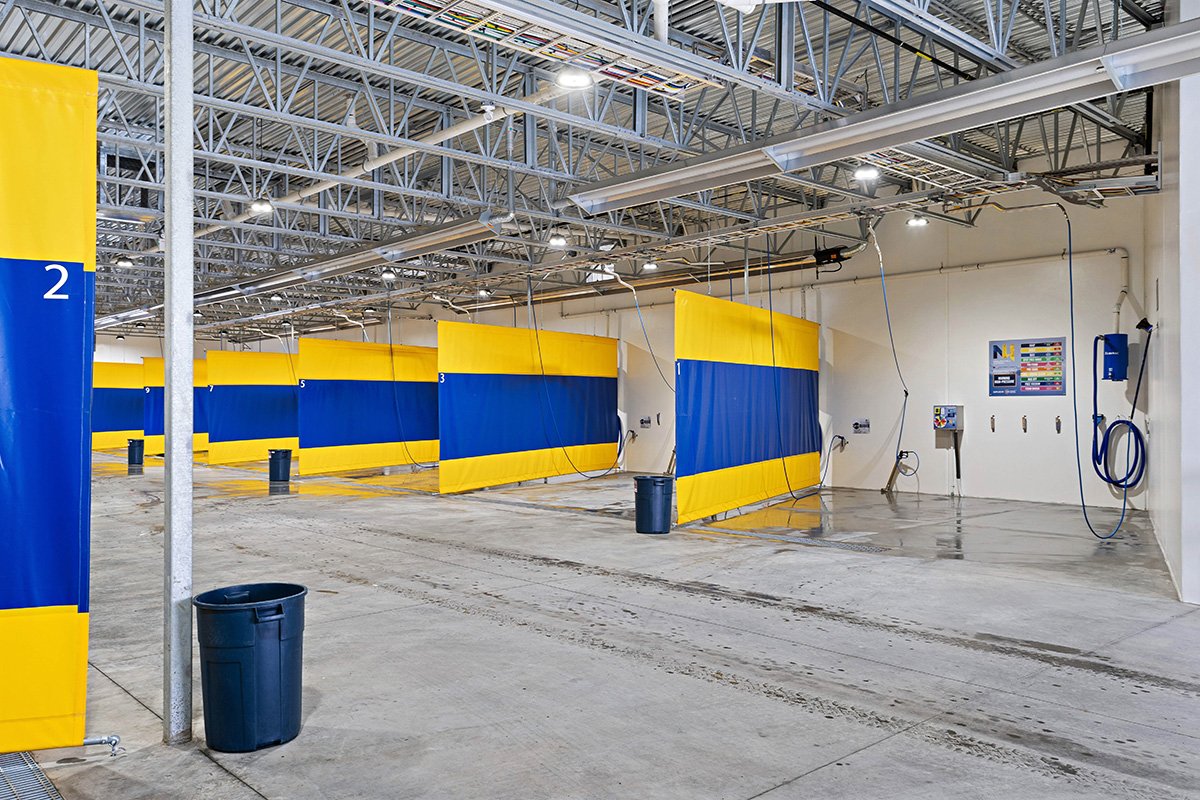
For operators running an in-bay automatic or tunnel wash as their primary format, adding one or two self-serve bays can significantly expand revenue without requiring a full second facility. As a benchmark, industry data puts a single well-maintained self-serve bay at roughly $1,500 to $2,500 per month. Self-serve bays attract a distinct customer segment. Drivers who prefer to control the wash process themselves, owners of trucks and SUVs that require higher-pressure undercarriage cleaning, and customers washing motorcycles, trailers, or recreational vehicles that automated equipment cannot accommodate.
CCWS supplies and installs Coleman Hanna self-serve systems and Custom Kraft self-serve wash equipment, both proven performers in the Alberta market. Self-serve bays generate revenue at a per-minute or per-cycle rate, run largely unattended. It adds meaningful capacity to sites where the automated wash creates queue pressure during peak periods.
Why self-serve bays make sense as an ancillary addition:
- They serve vehicle types and sizes that automated equipment cannot handle, capturing revenue that would otherwise leave your site.
- They create a pressure-relief valve during peak automated wash queues, keeping customers on-site and spending rather than driving away.
- They are low-labour additions: payment is handled at the bay, and the customer does the work.
How do you decide which ancillary services to add first?
The best starting point depends on your site’s current layout, your primary customer profile, and how much capital you want to allocate. CCWS works through this analysis with clients as part of new build planning or expansion consulting. As a general framework:
- Vacuum islands first. They have the lowest incremental cost relative to revenue potential, and they leverage customers you already have on-site.
- Vending machines second. Minimal capital outlay, passive income from day one, no staffing required.
- Dog wash or mat cleaner third. Higher upfront cost than vending but proven ROI, and they attract new customer segments that diversify your revenue base.
- Self-serve bays fourth. The most capital-intensive ancillary addition, but the highest revenue ceiling, particularly on sites with large lots or existing automated wash queue pressure.
You can explore the full range of car wash equipment available through CCWS, including vacuum systems and self-serve units suited to Alberta operations.
Frequently asked questions
Are self-service dog wash stations profitable for car wash operators?
In most cases, yes. Industry estimates put self-serve dog wash revenue at roughly $18,000 or more annually with gross margins commonly in the 75 to 85 percent range, and equipment costs are generally recovered within 12 to 18 months. They also attract pet owners who may not have visited the site for a car wash, increasing overall foot traffic. Actual results depend on location and traffic.
How large does a lot need to be for a car wash?
Minimum lot size varies by format. A self-serve facility can work on roughly 0.4 to 0.5 acres with careful planning. An in-bay automatic needs about 0.5 to 0.75 acres. A full tunnel wash typically requires close to one acre, with roughly 225 feet of linear space to accommodate the tunnel and stacking lanes. CCWS can confirm whether a specific parcel can support your target format.
What should car wash vending machines sell to maximize revenue?
The highest-performing car wash vending machines stock a mix of premium detailing products, including ceramic sprays, microfiber cloths, and interior cleaners, alongside traditional items like air fresheners and tire shine. Published benchmarks put revenue at roughly $500 to $2,000 per month per machine at a busy site.
How much revenue does a car wash vacuum island generate?
At $2 to $4 per cycle on a high-traffic site, industry sources put vacuum island revenue in the range of $1,000 to $3,000 per month. Consistent utilization and low maintenance costs make vacuum islands one of the most reliable ancillary revenue streams on a car wash property.
What is the minimum space needed for a self-service dog wash bay?
A compact self-serve dog wash unit can fit in as little as 100 square feet, making it one of the most space-efficient revenue generators available. Units are plumbed into your existing water supply and require a standard electrical connection.
Maximize every square foot of your car wash property
CCWS designs and builds car wash facilities across Alberta with long-term revenue per square foot in mind. From vacuum islands and self-serve systems to full site layout planning, our team helps operators build ancillary revenue into the facility from day one rather than retrofitting it later.
If you are planning a new build or looking to expand an existing facility with ancillary services, call CCWS at 403-690-6793 or contact the CCWS team to explore your options.
Add CCWS as a Preferred Google Source to prioritize our insights.