
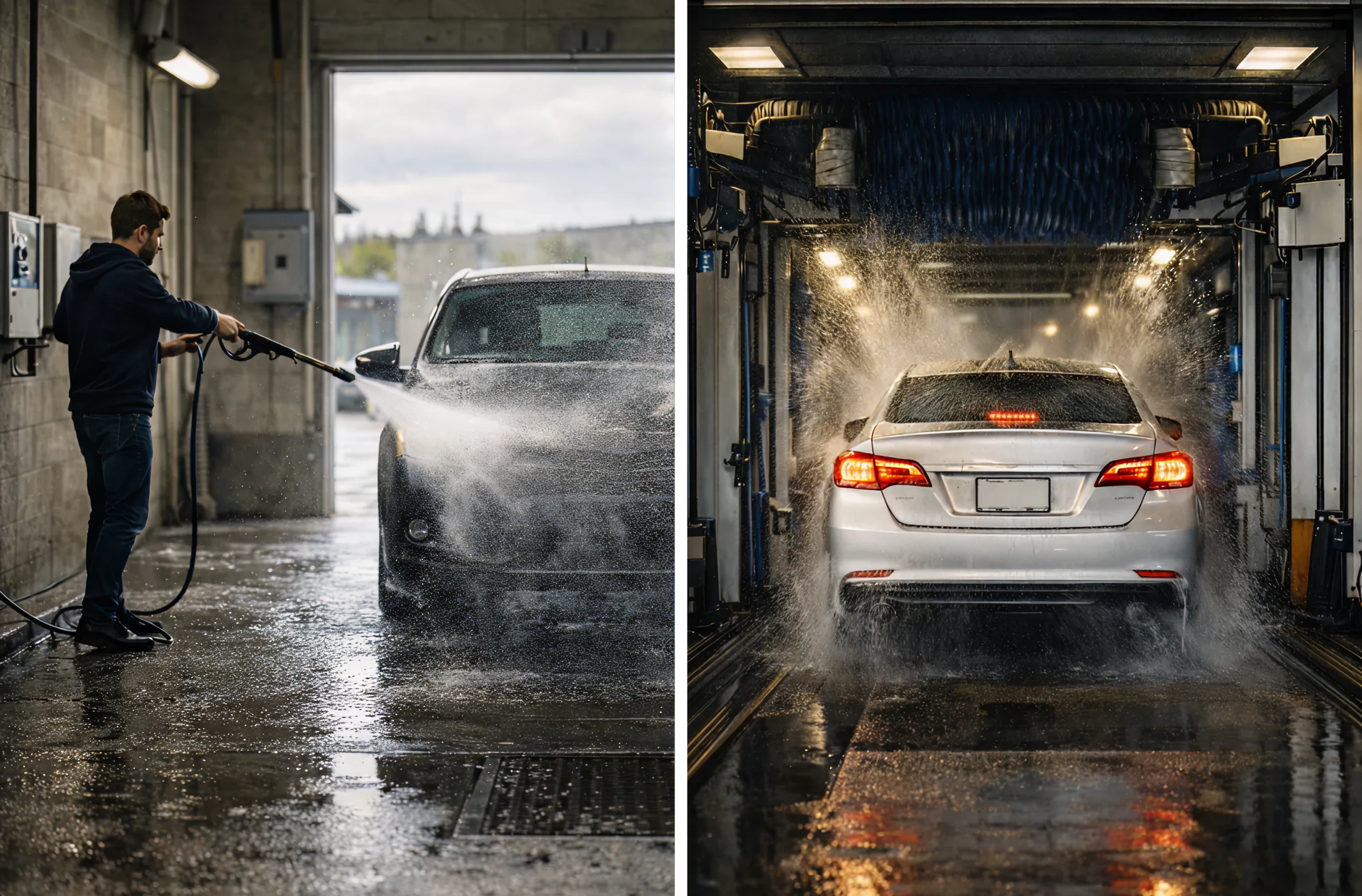

One of the first decisions investors face when entering the car wash business is choosing the right operating model. The two most common options are self-serve car washes and automatic car washes. Each model has advantages, limitations, and ideal use cases depending on location, customer behavior, and investment goals.
There is no universal answer. The right choice depends on your market.
This article breaks down the key differences between self-serve and automatic car washes to help investors make an informed decision.
Understanding Self-Serve Car Washes
Self-serve car washes allow customers to wash their own vehicles using coin-operated or card-based bays. These facilities typically include multiple wash bays and sometimes add-on features like vacuums or vending machines.
Advantages of Self-Serve Car Washes
Self-serve washes generally require lower upfront capital compared to fully automated systems. Construction costs are often lower, equipment is simpler, and ongoing maintenance can be more predictable.
Other benefits include:
- Lower labor requirements
- Flexible pricing per bay
- Appeal to price-conscious or hands-on customers
- Strong performance in rural or lower-density markets
Because customers do the work themselves, operating costs can remain relatively stable over time.
Limitations of Self-Serve Car Washes
Self-serve facilities typically generate lower revenue per customer compared to automatic washes. They are also more sensitive to weather conditions and may experience slower growth in markets where convenience is a priority.
In many urban areas, younger and higher-income customers increasingly prefer fast, automated solutions over self-washing.
Understanding Automatic Car Washes
Automatic car washes use tunnel or in-bay systems that clean vehicles quickly with minimal customer involvement. These washes are often paired with membership programs and digital payment systems.
Advantages of Automatic Car Washes
Automatic washes are designed for volume, speed, and convenience. When properly located, they can produce strong and consistent revenue.
Key advantages include:
- Higher revenue per vehicle
- Faster throughput during peak hours
- Strong compatibility with subscription memberships
- Greater appeal in urban and suburban markets
Automation also allows for pricing tiers and upsells, which can significantly increase average transaction value.
Limitations of Automatic Car Washes
Automatic car washes typically require higher upfront investment. Equipment, site design, and construction costs are higher, and poor site selection can negatively impact performance.
These facilities also rely heavily on traffic flow, visibility, and stacking capacity. If the site cannot support consistent vehicle volume, returns may suffer.
Matching the Model to Your Market
The most successful car wash projects align the business model with local demand and site characteristics.
Self-Serve Works Best When:
- The market is rural or semi-rural
- Land costs are lower
- Customers are more price-sensitive
- Traffic volume is moderate rather than high
Self-serve washes often perform well in smaller communities where convenience is less critical and operating costs need to stay lean.
Automatic Works Best When:
- The site is located on a high-traffic corridor
- The market values speed and convenience
- Population density supports high wash volume
- Membership programs can be actively marketed
In many growing Canadian cities, automatic washes outperform self-serve models due to changing consumer expectations.
Hybrid Models Are Becoming More Common
Some investors are choosing hybrid sites that combine self-serve bays with automatic systems. This approach allows operators to serve multiple customer segments while diversifying revenue streams.
Hybrid models can work well in transitional markets where demand is split between convenience-focused and price-focused customers.
Key Factors to Consider Before Deciding
Before committing to a model, investors should evaluate:
- Traffic counts and access points
- Demographics and income levels
- Local competition and saturation
- Utility capacity and environmental regulations
- Long-term scalability goals
A feasibility study can help determine which model aligns best with projected demand and return targets.
Final Thoughts
Choosing between a self-serve and automatic car wash is not about which model is better overall. It is about which model is right for your specific market.
Self-serve washes offer simplicity and lower risk in the right locations. Automatic washes provide higher upside when paired with strong sites, modern systems, and effective marketing.
Successful investors focus on matching the business model to local conditions rather than forcing a one-size-fits-all approach.
If you are evaluating a car wash project and want help determining the most suitable model for your market, CCW Solutions works with investors from feasibility and site selection through to design, build, and launch.


