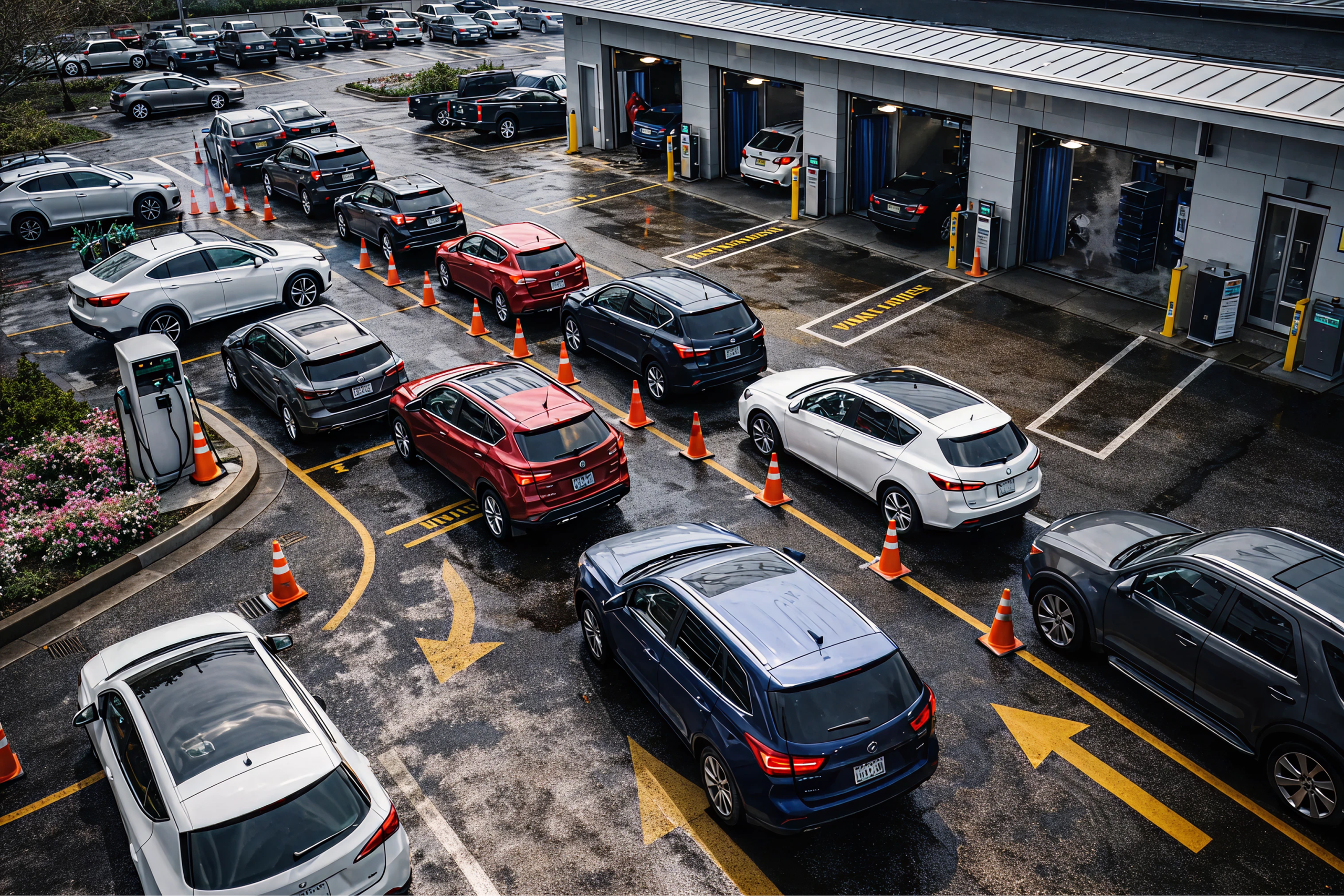

At high-performing car wash locations, demand is often not the problem. The challenge is moving vehicles through the site efficiently. Poor traffic flow and limited vehicle stacking can lead to congestion, long wait times, and lost revenue, especially during peak hours.
Improving traffic flow and stacking capacity helps capture demand more effectively and improves the overall customer experience.
Understand Where Bottlenecks Occur
The first step in improving traffic flow is identifying where delays happen. Bottlenecks often occur at entry points, pay stations, or wash loading areas.
Common problem areas include:
- Confusing site entrances
- Slow payment or selection processes
- Insufficient stacking before the wash entrance
- Poorly marked exit routes
Observing vehicle movement during peak periods provides valuable insight.
Optimize Entry and Exit Points
Clear and intuitive access reduces hesitation and improves flow. Vehicles should be able to enter and exit the site without complex turns or crossing paths.
Improvements may include:
- Dedicated entry and exit lanes
- Right-in and right-out access where possible
- Clear pavement markings and signage
Simpler access reduces backups and improves safety.
Increase Effective Stacking Capacity
Stacking refers to the number of vehicles that can wait on site without spilling onto public roads. Insufficient stacking often leads to lost business.
Ways to improve stacking include:
- Reconfiguring lane widths and alignments
- Removing unnecessary obstacles
- Using single-file lanes to maximize space
Even small layout changes can increase effective capacity.
Speed Up the Payment Process
Payment delays are a major contributor to congestion. Reducing transaction time improves overall throughput.
Effective strategies include:
- Upgrading to faster payment kiosks
- Promoting membership programs with automatic access
- Simplifying wash package selections
Faster payment means fewer vehicles waiting in line.
Improve Signage and Driver Guidance
Clear signage helps customers move confidently through the site. Confusion causes hesitation, which slows everyone behind.
Important signage includes:
- Entry and queue instructions
- Pay station guidance
- Clear exit directions
Well-placed signs reduce uncertainty and improve flow.
Manage Peak Periods Proactively
Peak demand periods require active management. Staffing or monitoring during busy times can prevent minor issues from becoming major disruptions.
On-site oversight helps:
- Resolve payment issues quickly
- Guide vehicles into proper lanes
- Maintain consistent spacing
Small interventions can keep traffic moving smoothly.
Consider Design Changes for Long-Term Improvement
For consistently busy sites, structural improvements may be necessary. This could include adding lanes, extending stacking areas, or reorienting equipment.
While these changes require capital investment, they can significantly increase throughput and revenue over time.
Final Thoughts
Traffic flow and vehicle stacking directly impact how much revenue a car wash can generate during peak periods. Sites that move vehicles efficiently capture more demand and provide a better customer experience.
Operators who continually evaluate and refine site flow are better positioned to grow without adding new locations.
If you are operating a busy car wash and want help evaluating traffic flow or planning site improvements, CCW Solutions works with owners and investors to design layouts that maximize throughput and performance.
Add CCWS as a Preferred Google Source to prioritize our insights.